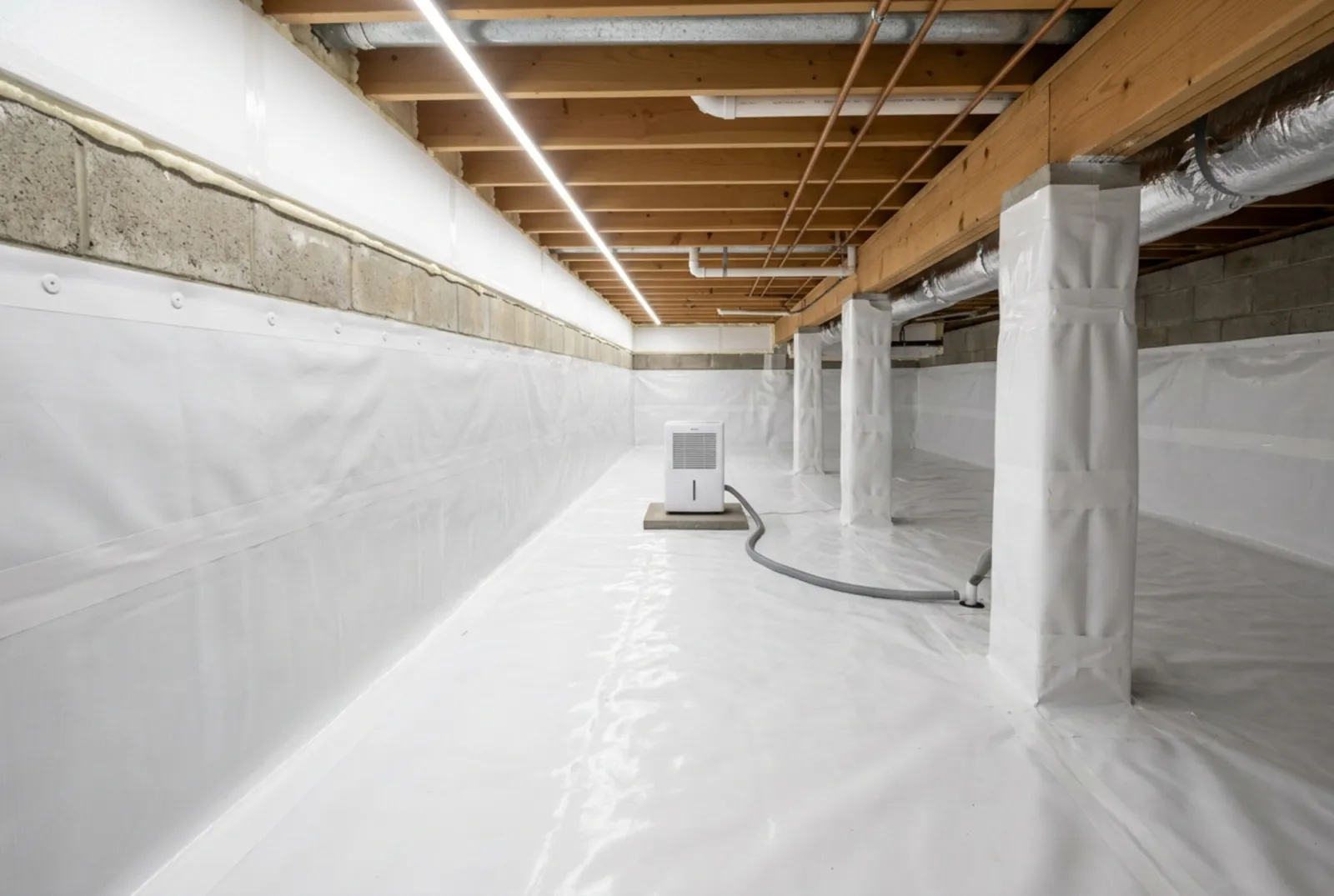
Crawl Space Dehumidifier & Moisture Control
Crawl Space Dehumidifier & Moisture Control in Charleston, SC
Summer air here is hot and wet. See what a crawl space dehumidifier can and cannot do.
Why Summer Air Fills the Space Under a Floor
A crawl space dehumidifier is a machine that removes water vapor from the air under a building. Moisture control is the bigger job around it: keeping water out, keeping humid air out and keeping wood dry.
This page covers humidity, mold, insulation and dehumidifier sizing. For liners and sealed vents, see crawl space encapsulation and vapor barriers.
Signs the Air Under Your Floor Is Too Humid
Humidity problems often show up inside the house first:
- A musty smell that gets worse in summer. It can mean damp air or wet materials below.
- Doors and drawers that stick in warm months, which can point to moisture in the wood.
- Beads of water on cold ducts or pipes. That can mean humid air meeting a cool surface.
- Dark or fuzzy spots on joists and subfloor. Only testing can say if it is mold.
- Insulation that sags, looks wet or has fallen.
- Floors that feel cold, soft or springy over one spot.
Several causes look alike. Only an inspection shows which one you have.
Dehumidifier, Insulation, Sealing or Drainage
Each fix answers a different problem. Pick by the cause, not by the product.
| Fix | What it does | Fits when | Limits |
|---|---|---|---|
| Crawl space dehumidifier | Removes water vapor from the air and sends it out through a drain or pump | The space is closed up and the air stays damp | Cannot keep up with open vents or running water |
| Insulation changes | Slows heat moving through the floor or walls | Old insulation is wet, loose or missing | Does not remove moisture |
| Sealing the space | Liner, taped seams and closed vents cut off outside air | Humid air leaks in from outdoors | Needs a plan for upkeep, covered on the encapsulation page |
| Drainage work | Moves rain and ground water away from the building | Water pools or the ground stays wet | Needs a lower place to send the water |
Full sealing is on our encapsulation page. Wet ground is on our drainage and water control page.
How a Crawl Space Dehumidifier Gets Picked and Set Up
- Find the moisture source. The visit looks at vents, ground, walls, ducts, insulation and the yard outside.
- Deal with water first. Gutters, grading and drains come before any machine.
- Close the air leaks. Open vents and gaps let humid air in. The plan says which to close.
- Size the dehumidifier. The contractor picks a crawl space dehumidifier that fits the size of the space and how damp it is.
- Plan the drain, power and checks. The unit needs an outlet, a place to send water and a filter or coil check. Ask who does that.
Drain, Power and Upkeep
A crawl space dehumidifier is not set and forget. It collects water, and that water needs a path out.
- Drain: gravity to a lower outlet, or a small pump when no lower outlet exists.
- Power: a nearby outlet, and a plan for what happens if the power goes out.
- Upkeep: dirty filters and coils slow the unit down.
- Alarm or check: a full bucket or failed pump can leave the space damp again.
What Moves the Price of Humidity Control
What changes the price of this work:
- How big the crawl space is and how tight the access is.
- The size and type of crawl space dehumidifier the space needs.
- Whether water leaves by gravity or by a pump.
- Electrical work to bring power to the unit.
- Insulation that must be removed or replaced.
- Sealing, drainage or cleanup the plan adds.
See cost ranges from other guides on our crawl space cost page.
Summer Air and Wet Ground in the Lowcountry
The SC State Climatology Office describes the state as mostly humid subtropical, with hot, humid summers. It says the state has no distinct dry season, and summer averages reach the mid 70s in the Lowcountry. Source: SC State Climatology Office climate overview.
Ground moisture matters too. In our NRCS sample of 233 natural-soil points across seven Charleston-area towns, 67 show a water table at the surface at some point in the year.
Census data does not say how many local buildings have crawl spaces, so only an inspection shows whether this applies to you.
Sources: SC State Climatology Office (undated, data through 2021); USDA NRCS Soil Data Access, queried October 5 and 6, 2026.
Crawl Space Dehumidifier Questions in Charleston, SC
Can a crawl space dehumidifier fix a wet crawl space on its own?
Not if liquid water is coming in. A crawl space dehumidifier handles moisture in the air. Standing water needs a drainage fix first, and many plans also close up the space so the dehumidifier is not fighting outside air.
Where does the water from a crawl space dehumidifier go?
It has to go somewhere. Some units drain by gravity to a lower outlet, and others use a small pump to move it out. Ask the contractor where the water will leave and who checks that path.
Does insulation help with damp air under the floor?
Insulation slows heat flow, but it does not stop moisture on its own. Wet insulation can sag and hold water against wood. A contractor can say whether yours should stay, move or be replaced.
Is a crawl space dehumidifier enough if the vents stay open?
Open vents let outdoor air in, and in summer that air is humid. Many plans close the vents first so the crawl space dehumidifier works on a smaller, closed space. See our page on full crawl space encapsulation for sealing details.
How do I know if the smell under my floor is mold?
Only testing can confirm mold. A musty smell, dark stains and damp wood point to moisture, and an inspection looks for the source. A contractor can suggest the next step.
Contact Us Today for a Free Estimate
Tell us what you notice under your floor. A licensed and insured contractor will look it over and give you a free estimate for crawl space moisture control in Charleston.